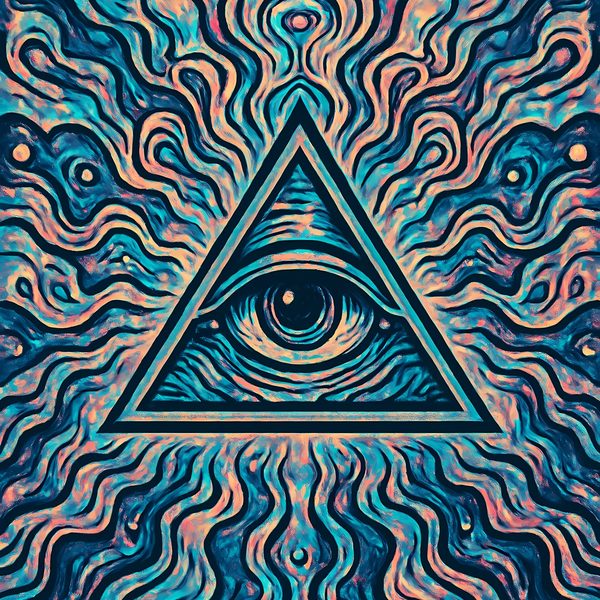
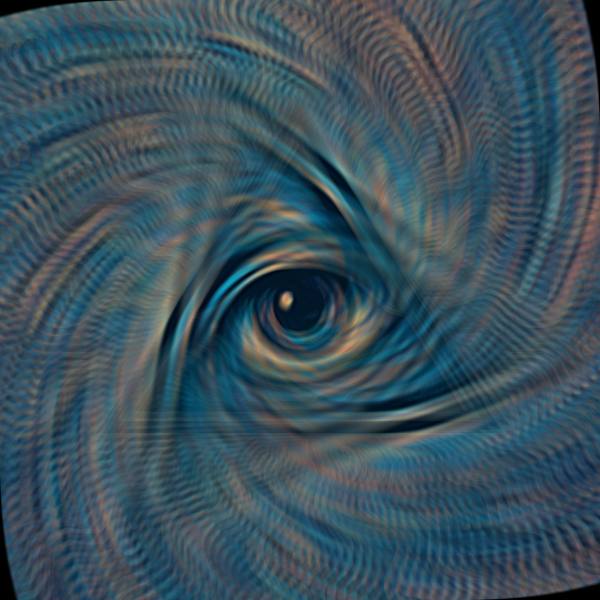
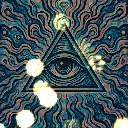
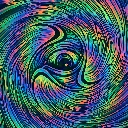
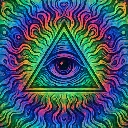
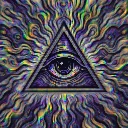
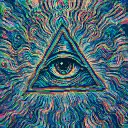
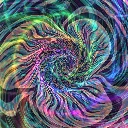
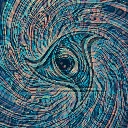
Vidicon Loop is a tunnel and feedback effect in FRCTL, the browser VJ studio. A camera pointed at its own monitor, simulated: the loop folds into spirals, pinwheels and labyrinths while the iris breathes the whole frame in and out.
Runs live on video, images, a camera or generated art. Stack it with any other effect, and route LFOs, envelopes or any of ten audio bands to its controls so it moves with the music.
Simulates a camera filming its own monitor. Each pass zooms and turns the held frame, softens it through a lens and adds it back, while the auto exposure holds the loop at the edge of running away. Focus past centre sharpens the loop into rainbow spirals and labyrinths, Negative flips brightness every pass for pinwheels, and Phase walks the colour round the wheel.
Using Vidicon Loop
Where it works
Spiral and pinwheel backdrops that keep themselves exposed on any source, from a dim club camera to a white logo. It runs in its own buffer, so it can sit anywhere in the stack rather than only last.
With the music
Nothing here listens to audio until routed. Send B1 (kick) to Zoom so each hit throws a ring out of the centre, and ride Focus on a fader to grow the labyrinth in and melt it back out. Iris near the top makes the frame breathe by itself.
Starting point
Leave the defaults for a painterly vortex, then push Focus to about two thirds for spirals, or switch Polarity to Negative and raise Rotate for a pinwheel.
Controls
Zoom
How far the camera is zoomed into its monitor. Centre holds the frame still, above it everything travels out of the middle, below it drains back in.
Rotate
Camera tilt against the monitor, per pass. Small turns curl the loop into spirals, large ones lock it into a symmetric rosette.
Polarity
Positive echoes the picture. Negative inverts its brightness every pass and keeps its colour, which turns echoes into pinwheels and spiral waves.
Focus
Centre is sharp. Below it the lens softens and the loop diffuses into smoke, above it the loop sharpens itself into stripes and labyrinths.
Gain
How much light makes it round the loop. Low is a short echo, past about four fifths the loop feeds itself faster than it fades.
Iris
Auto exposure. Off leaves the loop where Gain puts it. Raised, the iris keeps the frame exposed at the edge of running away whatever the source does, and near the top it overshoots so the frame breathes.
Phase
Hue error per pass, larger in the highlights than in the shadows. Centre is none, either side walks recirculated colour round the wheel.