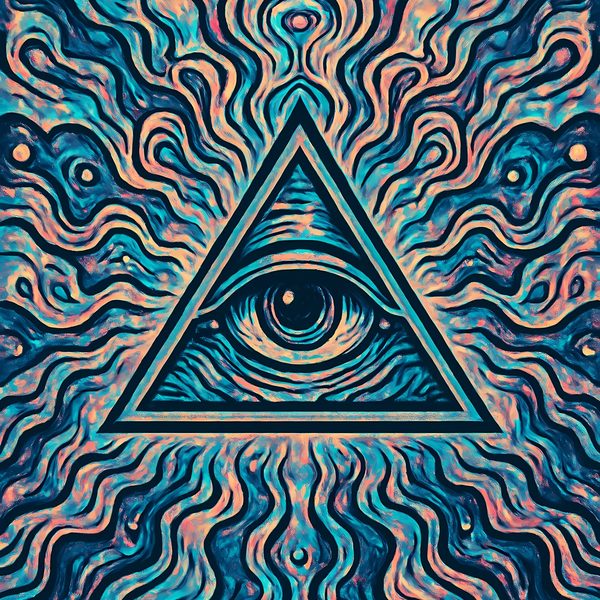
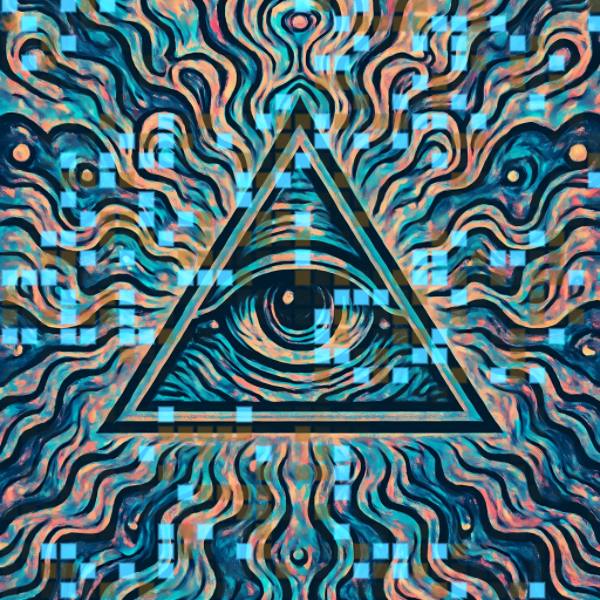
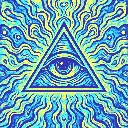
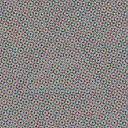
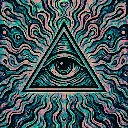
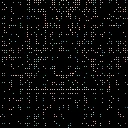
Brian’s Brain is a halftone and retro screen effect in FRCTL, the browser VJ studio. A three-state automaton that can never hold still — every firing cell has to spend a generation refractory, so the board is permanently full of travelling wavefronts.
Runs live on video, images, a camera or generated art. Stack it with any other effect, and route LFOs, envelopes or any of ten audio bands to its controls so it moves with the music.
A three-state board: a resting cell fires on exactly two firing neighbours, then sits out a generation before it can fire again. That rule never settles, so fronts keep travelling in straight lines, a light-blue firing edge trailed by darker orange spent cells. Afterglow sets how visible that trail is, Density how much fires at the start, and Glow the light each front throws.
Using Brian’s Brain
Where it works
Peak-time loops and drops that need constant motion without a feedback smear. Unlike Life Bloom it can't die out, and unlike Cyclic Automaton it leaves the picture showing between the fronts.
With the music
Generations tick on the clock, not the beat, so the fronts run regardless. Send B8 hats to Glow for the firing edges to flare with the hi-hats, and B1 kick to Revive to fire new cells from the picture on each kick.
Starting point
Scale at centre, Density at centre, Revive at a quarter, Afterglow at three-quarters, Glow at centre, Blend at three-quarters.
Controls
Scale
Size of one cell.
Density
How much of the board starts firing.
Revive
How often the picture fires a fresh cell. This rule sustains itself, so unlike Life this is here to keep tying the board to the clip rather than to keep it alive.
Afterglow
How visible the spent cells are behind a wavefront. They are what make the fronts read as travelling in a direction rather than as flickering.
Tint
Colour of a firing cell.
Glow
Extra light thrown by the firing front.
Blend
Weight of the board over the picture underneath.
Speed
Rate of the effect motion. Centre is the authored speed, hard left a tenth of it.