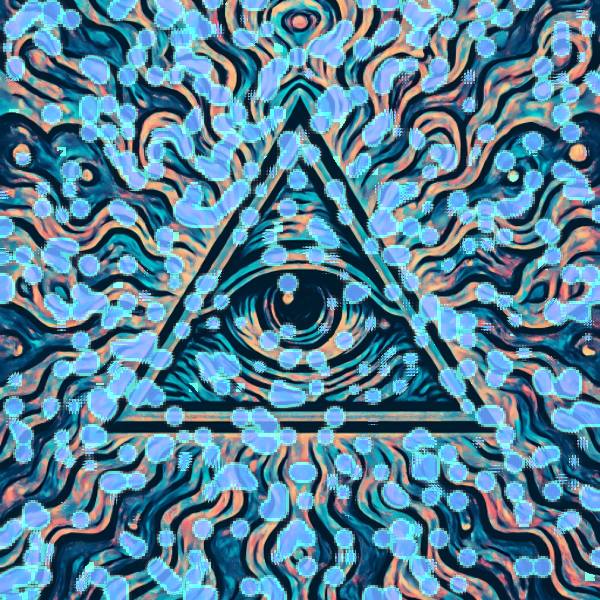
Gray-Scott Bloom is a liquid video effect in FRCTL, the browser VJ studio. Grows a live reaction across the frame — cells that swell, divide and eat into each other — seeded by the picture and never quite settling.
Runs live on video, images, a camera or generated art. Stack it with any other effect, and route LFOs, envelopes or any of ten audio bands to its controls so it moves with the music.
Grows a Gray-Scott reaction tuned to the dividing-cell species: round cells swell, split and push into each other in their own colour, with a brighter rim on each growing edge. The picture keeps dropping new seeds in, so it never settles. Feed and Kill pick the species, Scale sets cell size and growth speed, Growth the step rate, and Seed how much footage feeds in.
Using Gray-Scott Bloom
Where it works
Lab-culture visuals and long evolving loops for packs, since the reaction never repeats. Cells cover the picture in flat colour, so it suits abstract backdrops more than logos.
With the music
Seed decides how much footage drops in, so B1 (kick) on it seeds a burst of fresh cells on every kick. Feed and Kill are touchy, so give them MIDI knobs rather than audio.
Starting point
Feed centre, Kill centre, Scale a quarter, Growth three-quarters, Seed a quarter, Blend three-quarters, then nudge Kill in small steps to change species.
Controls
Feed
How fast fresh substrate arrives. Starve it and the pattern breaks into isolated cells; flood it and it closes into a solid sheet.
Kill
How fast the pattern is taken away again. Feed and Kill together are what pick the species — dividing cells, coral, worms or stripes — and the live ground is narrow, so move this in small amounts.
Scale
Size of one cell. This is the real rate control as well as the look: big cells cover the frame in a fraction of the steps small ones need.
Growth
How far the reaction advances each frame. Hard right is as fast as the model stays stable — past that it would shake rather than grow.
Seed
How much of the live picture keeps dropping into the reaction. At zero it grows once from the opening frame and then lives on its own; up high the footage keeps rewriting it and it never settles.
Tint
Colour of the reaction. The trailing edge sits a little further round the wheel than the front, so the pattern keeps some depth.
Blend
Weight of the reaction over the picture underneath.